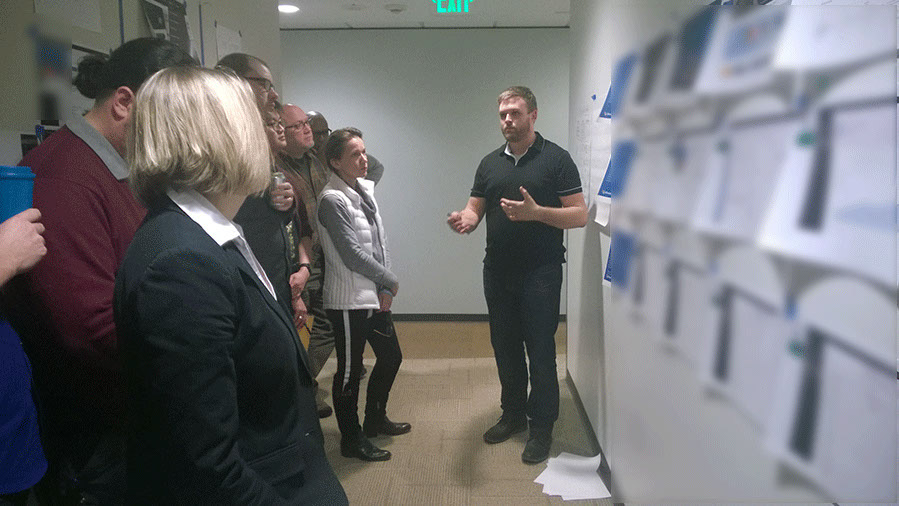
Design critique is one of the primary ways a design team develops shared judgment, scales quality, and confidence over time. On this team, critique existed as a recurring meeting and was highly valued by management, but it was not functioning as an effective tool.
After being promoted to Senior Designer, I identified critique as a failure point in how the team learned and collaborated. Rather than treating it as a facilitation issue, I approached it as a design problem: a system that needed clearer constraints, safer participation, and more reliable outcomes.
Before:
Design critique was scheduled twice weekly and was something leadership cared deeply about getting right. However, the preparation required to make it successful was never prioritized, and critique was assumed to be self-organizing. Expectations were unclear around when work should be presented and what kind of feedback designers could expect, which led to uncertainty about whether work was “ready” to be shown.
Because notes were not consistently taken, valuable feedback was often lost, resulting in repeated conversations and little continuity between sessions. Junior designers, in particular, were hesitant to present early or imperfect work out of fear of appearing “wrong.” Over time, these issues compounded, and critique was canceled more often than it was held. What should have been a core learning ritual became a source of anxiety and frustration for the team.
After:
My first priority was to make critique a psychologically safe environment where early and unfinished work was explicitly expected and supported. I took on the role of moderator to set this expectation clearly and to model the type of constructive, exploratory feedback the forum was intended to produce.
To address the reluctance to present, I mentored designers on how to prepare work for critique and clarified the purpose of the meeting so expectations were shared across the team. This reduced the friction and uncertainty around participation and led to more consistent attendance.
I also restructured the meeting so the designer presenting work was not responsible for moderating the discussion or capturing feedback. By separating these roles, critiques stayed focused and feedback was reliably documented, allowing insights to carry forward beyond the meeting itself.
Within two months, critique shifted from being a point of tension to a dependable team ritual. Participation increased, morale improved, and feedback became actionable rather than ephemeral. The process became strong enough that our senior manager began using it as an example to their manager and skip-level leadership of what the team was doing well.
Why This Mattered
Design critique is not just a meeting; it is a vehicle for learning and a valuable team trust building exercise. When it breaks down, teams lose momentum, confidence, and shared understanding. By redesigning critique I helped create an environment where designers could take risks earlier, learn faster, and trust the process.
The improved critique process strengthened collaboration within the team and increased leadership confidence in our design practice. It became a visible signal of team health and maturity, reinforcing design as a discipline that invests not only in outputs, but in the systems that produce them.